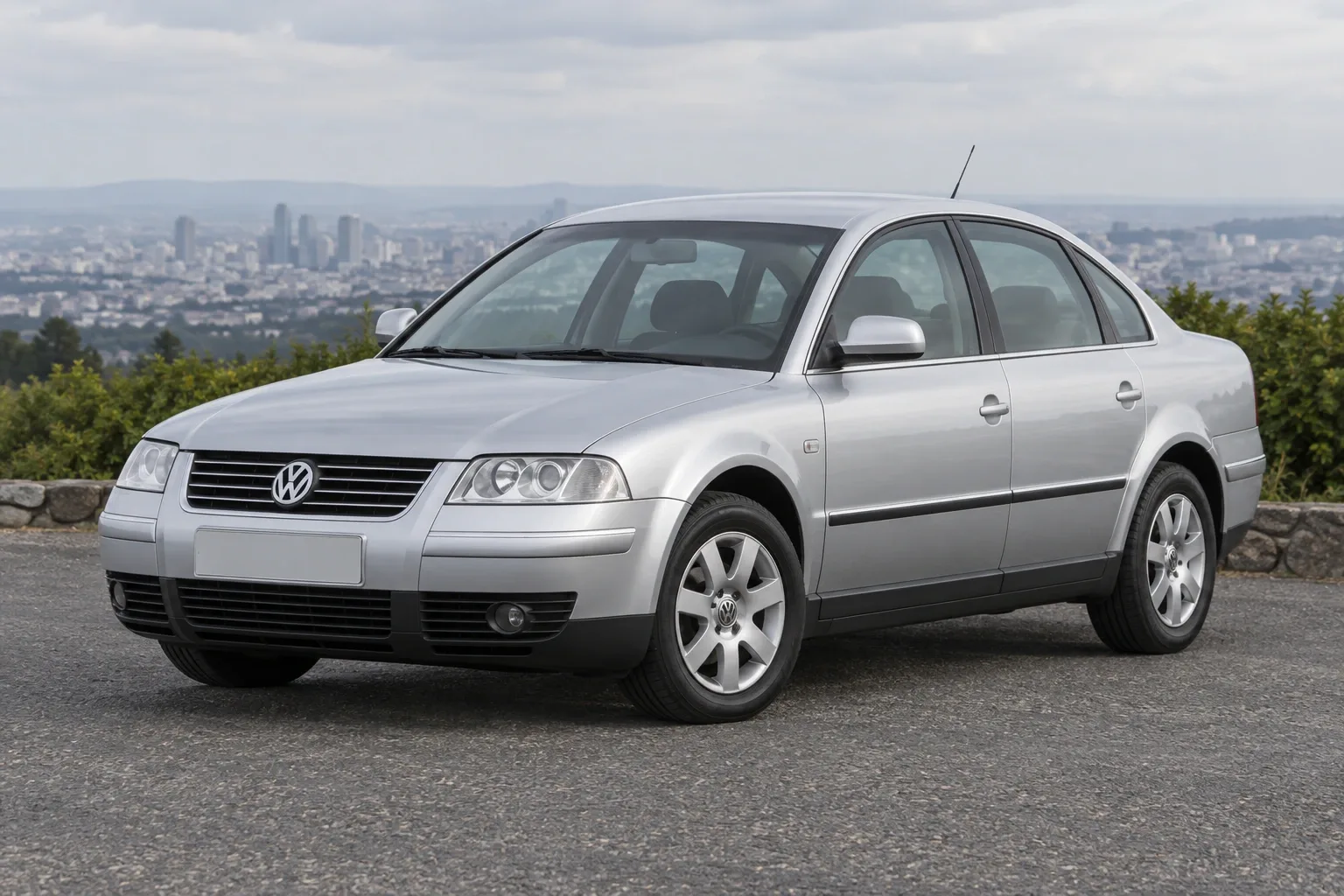
Volkswagen Passat B5
Volkswagen Passat B5 evaluation (1996–2005): condition, documents, inspection and conditions of sale of the car.
Indicative purchase price
Below market value
Final price agreed after inspection.
Value my car1Why buyers choose this model
Volkswagen Passat began its history in 1973 with the B1 model, identical to the Audi 80. The fifth-generation Passat B5 family has been in production since 1996. This series was unified with the same type of Audi A6 and A4, which allowed to equip it with more powerful and modern engines. The fifth series was offered in two body versions - a sedan and a station wagon "Variant". In 2001, the B5 underwent a restyling, which more touched the appearance of the car and only slightly technical side. The updated generation was designated B5.5 or B5+.
2What buyers check
Engines
The car was equipped with both gasoline and diesel engines. The line of gasoline engines was represented by units of 1.6 liters (101 hp), 1.8 liters (125 hp), 2.0 l (116 hp), 2.3 l (170 hp), 2.8 l (193 hp) and the flagship 4.0 l (275 hp). In addition, a gasoline turbo engine with a capacity of 1.8 liters (150 and 170 hp) was offered. The list of diesel units is not so large, it is represented by 1. 9 TDI (110 and 130 hp) and 2. 5 TDI (150 hp). All petrol engines meet Euro 4 standards and Euro 3 diesel engines. #1.6
4-cylinder gasoline 1.6 liters has two valves per cylinder. Its design features: mass-optimized trapezoidal rods, a reduced heat belt of pistons, due to which their weight is reduced, and an aluminum head of a cylinder block with roller cranks. The simplicity and reliability of the design allow us to call it one of the most reliable in the line, and the service is much cheaper than the rest. There are cases when the engine ran more than 500,000 km before the first overhaul. As a rule, the average period to the "capital" is at least 350 - 400 thousand km. The list of possible faults is very poor. After the 200,000 km mark, many owners begin to notice increased oil consumption. Often this happens due to the occurrence of oil removable rings, in this case, "excavating" will help. By this point, air suction in the ventilation system of crankcase gases begins - due to loss of tightness caused by the "aging" of materials. By 250,000 km, most likely, you will need to replace the gasket of the cylinder head. At about the same time, a crack in the exhaust manifold may appear. As a rule, everything begins with the gasket combustible, and the crack itself is often not noticeable - it is diagnosed only by the smell of exhaust gases and sound. After 280,000 km, some engines will need to replace fuel injectors (from 3000 rubles for an analog or 24 000 rubles for the original). The cause of failures in the revs during the discharge of gas can be the corrugated part of the plastic pipe from the pallet, in which holes may appear over time. # # 1. 8 and 1. 8T
Atmospheric 1.8 liters without major repairs goes up to 350-400 thousand km. The weak point is the hydraulic tensioner of the chain (from 7000 rubles for an analogue or 91,000 rubles for the original). It begins to rattle after 180-200 thousand km. Often the reason lies in the oil pump - due to the skewed valve, the oil pressure drops. The oil pump itself will serve 200-250 thousand km. With a run of more than 200,000 km, oil consumption increases to 1-1.5 liters per 1000 km. After 250,000 km, the camshaft leak appears, and high-voltage wires may need to be replaced. Nozzles live up to 300 000 km (3000 rubles for an analog or 11 000 rubles for the original). Petrol 5-valve engine 1.8 with turbocharging has the following design features: there is no intermediate shaft, the oil pump has a chain drive, the bottom of the pistons is cooled by a jet of oil, the ignition coil with a rod winding and a built-in terminal stage, the change of gas distribution phases occurs through a chain regulator for the camshaft of intake valves, and the cooling system pump with a drive from a gear belt. This motor is quite troublesome to operate. The problems depend on age. First of all, they arise due to the loss of seal seal seals in the places of connection of elements of the duct system to the engine - there is an air sucker and unstable operation of the engine with interruptions and failure in traction. Diagnosing the problem will help the procedure of "pressure". By 180,000 to 200,000 km, some owners had found a burning oil on the instrument board. ##2.0
2-liter gasoline engine without problems "rolls back" to 200-250 thousand km. It is made according to the traditional scheme with 2 valves per cylinder. Among the disadvantages are the appearance of stains from under the valve cover and tube, and an increase in oil consumption after 200,000 km. Oily appetite was officially recognized as a disadvantage and the manufacturer. As practice shows, major repairs correct the situation for a short time. A frequent cause of unstable engine operation is the "suction" of air. It occurs in the vacuum hoses of the fuel pressure regulator and in the upper ventilation hose of the crankcase. Often breaks off the "triplet" in the intake tube between the connection of ventilation crankcase gases and throttle valve. The weak point of the engine and the intake manifold is due to the membrane in the drive changing its geometry. On 2 liter Passats after a long parking, the start of the engine may be accompanied by a sound resembling a diesel. The reason is the reverse valve in the oil filter bracket. Most likely, he got out or clogged, not allowing oil to drain from the head of the cylinder block. Closer to 180-200 thousand km may have problems with the start - the engine starts from the 2nd time. The reason is a reverse valve in the fuel line, "putting" pressure. Hydrocompensators and oil caps will need replacement after 200,000 km. ##2.3 V5
The 2.3-liter petrol V5 is designed for 98th gasoline, but copes with the 95th. Its design features: 4 valves per cylinder, drive valves with roller snags, built-in camshaft, variable gas distribution phases for intake and exhaust valves, plastic intake pipe, intake path of variable length. Problems, like other engines, arise far beyond the mark of 200,000 km. Among them: the destruction of a plastic tee connecting three air hoses and plastic connections of ducts (cracks occur), DMRV (3-5 thousand rubles), a switch (6200 rubles), and a hydraulic tensioner chain. Hearing the "call", do not pull with the replacement of the hydraulic tensioner, there are cases of pistons meeting with valves. The only inconvenience - the timing system chain is between the engine and the box, and to replace it you will have to remove either the box or the engine. Set of timing system with a chain costs about 10 000 rubles, for work ask about 60 000 rubles. On the engines of the AGZ series in the cooling system installed an additional electric pump. Its life is about 250,000 km. When replacing, the Bosch analogue proved itself best. Often, instead of replacing, you can do with the repair of the electric drive of the pump - replacing the "brushes". Overheating of the engine can cause cracks in the head of the block between the valve seats. ## 2. 8 V6
Petrol 5-valve V6 2.8 liters has similar problems with the above engines. The engine is characterized by a large oil consumption - more than half a liter per 1000 km. The valve ventilation crankcase gases can cause the appearance of oil on the throttle. By 200,000 km, engine outages occur - often due to high-voltage wires and ignition coils. When working at idle, foreign sounds are often heard, the source is a working intake manifold. To 200-250 thousand km, it is necessary to replace the hydraulic tensioner of the chain and engine supports. When purchasing a Volkswagen Passat B5 with such a motor, more attention should be paid to engine compression - the occurrence of rings is not uncommon here. This engine is also voracious - up to 18 liters in the city, on the track the appetite is more moderate - 8-10 liters. # 4. 0 W8
The flagship 4.0 V8 is a very rare engine, and, as it turned out, not the most successful. There are cases of piston breakage due to detonation from poor-quality fuel. Repairs are in the amount of 180 000 rubles. In general, the engine is practically not repairable, and spare parts for it are scarce. Cases of jamming the engine are not unique. Among the typical problems are short-lived ignition coils and stretching of the timing system chain located on the rear side of the motor. Often the valve valve valve regulator fails. Less common parts are very expensive and getting them is not always easy. Due to the dense layout in the engine compartment, not every mechanic is taken on to repair the engine or replace attachments. It consumes up to 20 liters of water in the city. #1.9 TDI
Diesel 1.9 TDIs were installed in 2 types - with TNVD until 2001, and then with pump injectors. The timing system drive is belted. The cost of the full set is 14-20 thousand rubles. On diesel engines of 1.9 liters with a capacity of 100 hp, nozzles with a reduced diameter of the atomizer holes are installed, and on more powerful 130 hp - already with an increased diameter of the atomizer holes. In addition, the latter is a turbocharger of increased dimensions, the engine crankcase is made of materials that provide greater rigidity, the diameter of the crankcase supports for the crankshaft root bearing is increased, and the pistons are made of a material of increased strength. By 150,000 km, the turbine geometry valve may need to be cleaned. By 200,000 km, the coolant temperature sensor will need to be replaced. By this time, problems with starting begin to arise due to the reverse valve in the "tandemnik" (12,000 rubles). Camshaft is an officially recognized disease of the engine, manifested by 200-400 thousand km. Signs - a strong zumbing in the area of the air intake, knocking in the engine, loss of power with black exhaust. In this case, it is necessary to replace all pushers, the camshaft itself and adjusting screws with a spherical end. Hydrocompensators are replaced when running about 200-250 thousand km. After 250,000 km, the sealing rubber nozzles begin to pass fuel into the oil. When replacing the sealing rings on the pump-nozzles, the spring may break down - due to the design features of the adjusting bolt and the nozzle. The pump injectors themselves (1-4 thousand rubles) reach 300-400 thousand km. # # 2. 5 TDI V6
The diesel V6 2.5 TDI has proven itself on the positive side. Its design features: the maximum injection pressure is increased by installing an additional plunger in a high-pressure radial piston fuel pump, the number of holes on the nozzle sprayers is increased to 6 and the crankcase ventilation is improved. Problems with these engines are rare, one of them camshaft. There are two of them, the replacement will cost 30 000 rubles. If you run more than 240,000 km, you may need to replace the fuel pump. ##
The motors work in pairs, both with a manual and automatic transmission. #
Mechanical transmissions were installed 4 types. 5-speed 012/01W was used with all gasoline engines and diesel 1. 9 TDI 100 hp 5-speed 01A was installed on all-wheel drive models with gasoline 2.0, 2.3 and 2.8 liters - for all-wheel drive Passat B5 with turbo diesel 1. 9 TDI 130 hp and 2. 5 TDI in 5-speed version;
- 6-step for diesel 1.9 TDI from 130 hp and 2.5 TDI. By 220 - 250 thousand km, tangible sharp impacts may appear when the gears are turned on or the engine is braking. The reason is the backlash between the internal SRUS-om and the drive shaft. After 250-300 thousand km, a clutch and a two-mass flywheel (60-120 thousand rubles per set) fall under replacement. Clutch of gasoline versions is cheaper - about 15 000 rubles, and diesel - about 20-26 thousand rubles. 2 mass flywheel faster "ends" on diesel engines due to the huge torque and long driving at low revs, close to idling. In these modes, the torsion fluctuations of the rotating crankshaft are very high, which leads to accelerated breakage of the springs of the 2 mass flywheel (over 50,000 rubles). When running more than 300,000 km, wear of the needle bearing of the primary shaft or synchronizers will cause poor gear turn on. #
Automatic boxes were installed in 2 types: the classic 4-speed 01N (own development of VAG) and the 5-speed 01V (ZF 5HP19) with the ability to manually switch gears "Tiptronic". Among the possible malfunctions is overheating of the oil pump due to failure of the box (after 250,000 km) and, as a result, failure of the hydrotransformer. To this run, problems often arise due to the wear of the frictions, as well as the failure of the valve block and pressure regulator. In this case, can help washing the "hydroplate". Overheating of the oil causes interruptions in the work of the box. When the first signs appear, it is necessary to clean the engine radiator, in which the automatic transmission oil is also cooled.
3Pre-purchase checklist
1.6
- There are cases when the engine ran more than 500,000 km before the first overhaul.
- The list of possible faults is very poor.
- By this point, air suction in the ventilation system of crankcase gases begins - due to loss of tightness caused by the "aging" of materials.
- By 250,000 km, most likely, you will need to replace the gasket of the cylinder head.
- At about the same time, a crack in the exhaust manifold may appear.
- As a rule, everything begins with the gasket combustible, and the crack itself is often not noticeable - it is diagnosed only by the smell of exhaust gases and sound.
- After 280,000 km, some engines will need to replace fuel injectors (from 3000 rubles for an analog or 24 000 rubles for the original).
- Loss of tightness can cause oil starvation with all the ensuing consequences.
1.8 and 1.8T
- Atmospheric 1.8 liters without major repairs goes up to 350-400 thousand km.
- After 250,000 km, the camshaft leak appears, and high-voltage wires may need to be replaced.
- This motor is quite troublesome to operate. The problems depend on age.
- First of all, they arise due to the loss of seal seal seals in the places of connection of elements of the duct system to the engine - there is an air sucker and unstable operation of the engine with interruptions and failure in traction.
- Diagnosing the problem will help the procedure of "pressure".
- The reason is a clogged mesh of the oil receiver, for cleaning which it is necessary to remove the pallet (cardcase) of the engine.
- Km may appear knocking on the working engine.
- Experience shows that replacing them with a Ruville analogue is not the best solution.
2.0
- 2-liter gasoline engine without problems "rolls back" to 200-250 thousand km.
- As practice shows, major repairs correct the situation for a short time.
- km may have problems with starting - the engine starts from the 2nd time.
2.3 V5
- Problems, like other engines, arise far beyond the mark of 200,000 km.
- Among them: the destruction of a plastic tee connecting three air hoses and plastic connections of ducts (cracks occur), DMRV (3-5 thousand rubles), a switch (6200 rubles), and a hydraulic tensioner chain.
- Often, instead of replacing, you can do with the repair of the electric drive of the pump - replacing the "brushes".
- Overheating of the engine can cause cracks in the head of the block between the valve seats.
2.8 V6
- Petrol 5-valve V6 2.8 liters has similar problems with the above engines.
- km requires replacement of the hydraulic tensioner chain and engine supports.
- When purchasing a Volkswagen Passat B5 with such a motor, more attention should be paid to engine compression - the occurrence of rings is not uncommon here.
4.0 W8
- There are cases of piston breakage due to detonation from poor-quality fuel. Repairs are in the amount of 180 000 rubles.
- In general, the engine is practically not repairable, and spare parts for it are scarce. Cases of jamming the engine are not unique.
- Among the typical problems are short-lived ignition coils and stretching of the timing system chain located on the rear side of the motor.
- Due to the dense layout in the engine compartment, not every mechanic is taken on to repair the engine or replace attachments.
1.9 TDI
- By 200,000 km, the coolant temperature sensor will need to be replaced.
- By this time, problems with starting begin to arise due to the reverse valve in the "tandemnik" (12,000 rubles).
- Signs - a strong zumbing in the area of the air intake, knocking in the engine, loss of power with black exhaust.
- In this case, it is necessary to replace all pushers, the camshaft itself and adjusting screws with a spherical end.
- A little later there is cracking of the GBC (over 100,000 rubles for repairs).
- km no-no and have to go to the service for major repairs of the engine (about 250 000 rubles).
2.5 TDI V6
- Problems with these engines are rare, one of them camshaft.
- There are two of them, the replacement will cost 30 000 rubles.
- If you run more than 240,000 km, you may need to replace the fuel pump.
ICSW
- The reason is the backlash between the internal SRUS-om and the drive shaft.
- With a run of more than 300,000 km, wear of the needle bearing of the primary shaft or synchronizers will cause poor gear turn-on.
DISTRIBUTION
- Among the possible malfunctions is overheating of the oil pump due to failure of the box (after 250,000 km) and, as a result, failure of the hydrotransformer.
- To this run, problems often arise due to the wear of the frictions, as well as the failure of the valve block and pressure regulator.
- When the first signs appear, it is necessary to clean the engine radiator, in which the automatic transmission oil is also cooled.
- Often after this procedure and changing the oil in the box, the problems go away.
- Soon begin to "leak" the glands of the box (400-2500 rubles).
- It is very important to monitor the condition of the oil and filter in the box, especially after 250,000 km.
- For a complete repair in the service will ask 80-100 thousand rubles.
Walking
- ABS block is often repaired without serious investment.
- If a geyser appears in the tank of the power steering, a replacement of the tank will be required. The reason is the flying grid.
- When running more than 200,000 km, the steering rails begin to flow. She starts knocking later.
- Only its replacement will help (22 000 rubles for an analog or 66 000 rubles for the original, plus 5000 rubles for work).
- Trying to eliminate the knock by pulling up the rack will save you for a short time, but it will greatly load the pump GUR.
Body and salon
- On adult Passats, corrosion foci occur in places intended for mounting a jack, on the front wings along arches and under the under-arms, on the thresholds, the windshield frame, in the area of handles and door modlings.
- Clogged drainage holes under the battery and vacuum brake booster can cause an "aquarium" in the engine compartment, there are also corrosion foci.
- By 250,000 km, the mechanisms of lifting the glasses fail due to the destruction of the mechanism runner, plastic glass holders or a rope break.
- In addition, the control unit windows fails (from 1000 rubles for an analog or 12 000 rubles for the original).
- Water, once in the cabin, can cause a lot of problems to the owner of the car, getting into the comfort unit (3000 rubles per used), located under the feet of the driver.
- In addition, under the mats rots the wiring, and the floor is attacked by corrosion.
- Due to wear, the tide on the visor of the guides eventually ceases to close the hatch.
- Electricity starts delivering problems after 200,000km.
4Challenges of selling privately
Previously, the Volkswagen Passat B5 claimed the title of the national “budget” car. The cost of spare parts was not so high. Today, Passat is overgrown with senile sores, requiring more and more attention.
- Engines: The car was equipped with both gasoline and diesel engines.
- Transmissions: The motors work in pairs with both a manual and automatic transmission.
- ABS block is often repaired without serious investments.
- Body and salon: On adult Passats, corrosion foci occur in places intended for jack installation, on the front wings on arches and under the under-arms, on the rapids, windshield frame, in the area of handles and door modlings.
Shows, bargaining and re-registration take time: buyers look, promise to think and disappear. Fair price after inspection closes the auction on the spot. If money is needed urgently, the purchase takes away waiting and repeat displays.
5How selling to us works
Leave a request with the car data. We will discuss the preliminary assessment and inspection. After checking the status and documents, we agree on the final price and terms of the transaction.